
This product is for research use only, not for human use. We do not sell to patients.
| Size | Price | Stock |
|---|---|---|
| 250mg | $90 | 3-6 Days |
| 500mg | $140 | 3-6 Days |
| 1g | $230 | 3-6 Days |
| 2g | $400 | 3-6 Days |
 :
: Cat #: V1637 CAS #: 102625-70-7 Purity ≥ 99%
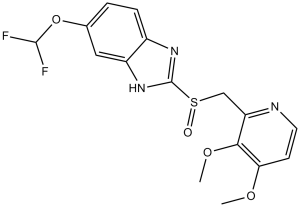
Description: Pantoprazole (BY1023; SKF96022; BY-1023; SKF-96022; Protonix), an approved anti-ulcer drug, is a proton pump inhibitor (PPI) used for short-term treatment of erosion and ulceration of the esophagus caused by GERD (gastroesophageal reflux disease). Pantoprazole acts by inhibiting the activity of H+/K+-ATPase proton pumb in the parietal cells of gastric mucosa. This inhibition affects the acid secretion and thus, pantoprazole are used as drugs for the treatment of various acid-related disorders. Pantoprazole is activated slowly. The activated sulfonamide of pantoprazole binds to Cys813 and Cys822 of the pumb and inhibits acid secretion selectively.















Publications Citing InvivoChem Products


















Product Promise

- Physicochemical and Storage Information
- Protocol
- Related Biological Data
- Stock Solution Preparation
- Quality Control Documentation
| Molecular Weight (MW) | 383.37 |
|---|---|
| Molecular Formula | C16H15F2N3O4S |
| CAS No. | 102625-70-7 |
| Storage | Powder -20°C 3 years 4°C 2 years In solvent -80°C 6 months -20°C 1 month |
| Synonyms | BY1023; SKF96022;Protonix; BY 1023; SKF 96022;BY-1023; Pantozol; Protonix; Pantoprazolum; Pantoprazol; Pantoloc; BY-1023;SKF-96022 |
| Solvent volume to be added | Mass (the weight of a compound) | |||
|---|---|---|---|---|
| Mother liquor concentration | 1mg | 5mg | 10mg | 20mg |
| 1mM | 2.6084 mL | 13.0422 mL | 26.0845 mL | 52.1689 mL |
| 5mM | 0.5217 mL | 2.6084 mL | 5.2169 mL | 10.4338 mL |
| 10mM | 0.2608 mL | 1.3042 mL | 2.6084 mL | 5.2169 mL |
| 20mM | 0.1304 mL | 0.6521 mL | 1.3042 mL | 2.6084 mL |
This equation is commonly abbreviated as: C1 V1 = C2 V2
- (1) Please be sure that the solution is clear before the addition of next solvent. Dissolution methods like vortex, ultrasound or warming and heat may be used to aid dissolving.
- (2) Be sure to add the solvent(s) in order.